But his career is a fascinating artefact or barometer of
Australian film culture with a characteristically Melbourne
intonation. Although Dalmas was an energetic, frenetic,
immediate and partly drug-fuelled experiment in forking narrative and
collaborative filmmaking it was both a product of its time and a
summation of the work Deling had undertaken as a programmer, critic,
collaborator, mentor and filmmaker over the previous decade.
Deling
was a key figure in the Melbourne University Film Society (MUFS) from
the early 1960s. He had a significant role in shaping the society’s
programming at a particularly important juncture when the full impact
of the nouvelle vague and its critical and filmmaking ethos
was being felt. Deling was a central figure in translating this ethos
into its antipodean form, though his initial attempts at filmmaking
under very unsupportive conditions never made it to the screen. His
major contributions to what Bruce Hodsdon calls the “Carlton
ripple” took longer to arrive and provide something of an endnote
to this movement or school. That said, Deling can still be glimpsed
in a small role in Brian Davies’ landmark first feature, Pudding
Thieves (first shown in 1967 but in production for four years),
and his erudite writing on a range of films and filmmakers throughout
the 1960s can be read across the publications produced by MUFS. On
the basis of this body of work it is clear that Deling was one of the
major, if under-recognised, Australian film critics of the era. Many
of his articles and programs focus on the work of Hollywood auteurs
like Anthony Mann, Frank Tashlin, John Ford and Alfred Hitchock, but
he also wrote on key European directors like Luchino Visconti and
Joseph Losey (in exile).
Both
Deling and Davies also wrote and spoke about the possibilities and
opportunities for filmmaking in Melbourne from the early 1960s,
taking advantage of the increasing accessibility of equipment (if
still very limited) and the “make do” and “get out into the
streets” spirit of the nouvelle vague. This is explicit in
his article from Annotations on Film in late 1963, “The
Local Scene”, which draws inspiration from the Jacques Rivette’s
innovations in making Paris nous appartient (1961), comments
positively on the independent work then being undertaken by Tim
Burstall at Eltham Films, and lambasts the practitioners working in
advertising, government film and television for their lack of
ambition in taking advantage of these conditions and opportunities.
Unlike
Davies, who made two features in the mid to late 1960s that preceded
the changing conditions of support that led to the “revival” of
Australian feature filmmaking in the mid-1970s, the stalling of
Deling’s filmmaking career was serendipitous. Although Deling is
sometimes claimed as the doyen of underground filmmaking in
Melbourne, both of his first two features received significant
government support. Around half of Dalmas’ $20000 budget was
provided by the Experimental Film and Television Fund (est. 1970),
while much of Pure Shit’s $28000 budget was covered by the
Buoyancy Foundation (an organisation set up to help drug takers) and
the Film, Radio and Television Board of the Australia Council. Deling
was able to take advantage of a brief window, before the
establishment of the Australian Film Commission in 1975, that offered
a more favourable environment for both commercial (for example,
1972’s The Adventures of Barry McKenzie was totally
government funded) and experimental modes of film practice.
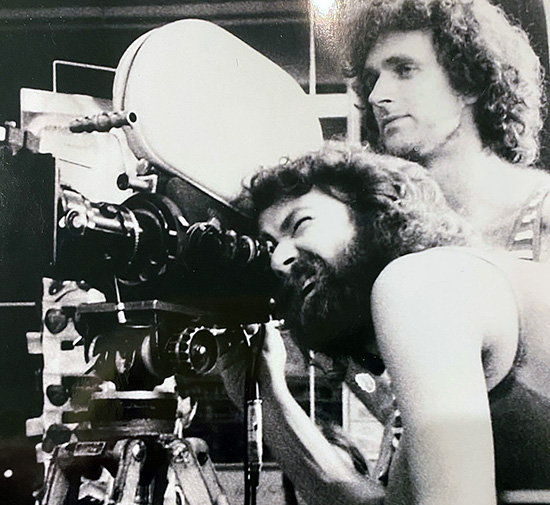
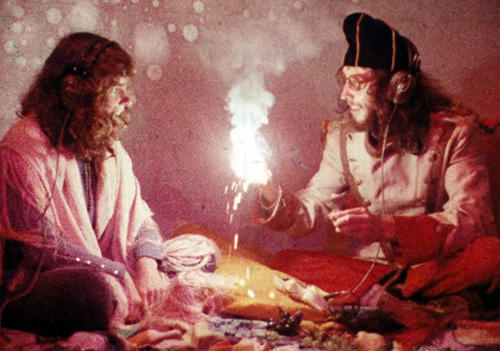
Most
likely influenced by the work of filmmakers such as Jean-Luc Godard
and Norman Mailer, Dalmas took four years to complete and is
remarkable for its collaborative mode of making. Although Deling had
relative control over the first half of the film, in the second the
established fiction breaks down, and the film is taken over by the
crew, actors and previously fictionalised subjects. An exploration of
the drug scene becomes a manifestation of it, the camera taken up by
whoever chooses to do so. The final film was then woven together by
Deling. Given a short season at the Australia Twin Cinema in
Melbourne, it went on to be largely distributed through the film
co-operatives.
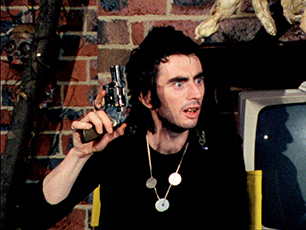
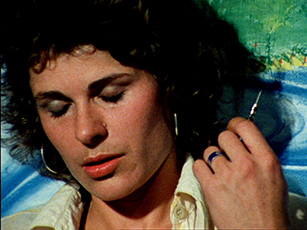
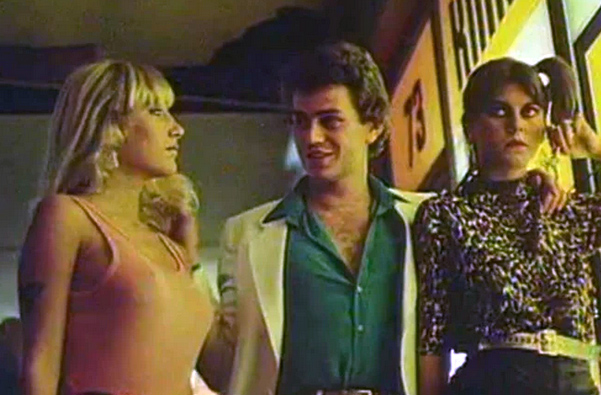
Pure
Shit emerged from Deling’s work with the Buoyancy Foundation
and his observations of the impact that heroin and other hard drugs
were having on acquaintances in inner-city Melbourne. Shot over an
intense four-week period it has the feeling of being situated
“within” this scene, featuring several actors who were indeed
taking drugs during production. But it is a much more controlled film
than Dalmas, plainly shot in an immediate, intimate, live
“environment” but also carefully scripted, directed and designed.
In preparation for the film, Deling showed Howard Hawks’ His
Girl Friday (1940) to the cast and crew, the production
drawing on its sense of energy and whip-smart overlapping dialogue,
but translating this to a more down-at-heel and consciously
desperate, speed-induced milieu. Pure Shit had its first
screening at the Perth Film Festival the week after the world
premiere of Peter Weir’s Picnic at Hanging Rock (1975), but
due to significant problems with censorship it didn’t receive a
commercial release until May the following year. Although it was
eventually shown uncut, its title was modified (to Pure S) and
all of its marketing carefully scrutinised by the censors. Drawing on
this notoriety, and the positive reviews it generally received, it
opened at the Playbox Cinema in Melbourne and went on to become a
modest success. It also received AFI Award nominations for Best Film
and Best Director, losing out, inevitably, to Fred Schepisi’s The
Devil’s Playground (1976).
On
the basis of this “one-two punch” Deling should have gone on to
become one of the key Australian directors across the following
decades. Instead, his career is emblematic of a more common trend
that sees filmmakers working less productively and personally across
film development, script editing, screenwriting and occasional,
piecemeal modes of direction. But I also think that Deling’s two
most celebrated films are not necessarily an indication of his
overriding interests or the direction his career could have taken.
His following feature, Dead Easy (1982), is a genre-exercise
in keeping with the more outwardly commercial orientation and
opportunities of the 10BA era and, like many of its ilk, failed to
receive a cinema release. Deling went on to write and direct a bigger
budgeted TV movie, Keiron: The First Voyager (1985), before
his career shifted gear to screenwriting work on the children’s
series The Ferals (1995), the video game Choose Your Own
Nightmare (1998) and, finally, on 13 listed episode credits in
the “writing room” for Neighbours between 1999 and 2003.
In the period after Pure Shit, he is also listed as directing
an episode of Young Ramsay (1980), providing the story for the
TV movie Matthew and Son (Gary Conway, 1984), as associate
director on Nat Young’s surfing documentary Fall-Line (1977), and as the writer of two episodes of the well-regarded ABC
series, Sweet and Sour (1984). But this peripatetic rollcall
only tells part of the story, and doesn’t take account of the many
projects that never came to fruition. In some ways, Deling’s is a
fascinating, eclectic and even illustrative body work that stretches
from the insular screen culture of MUFS, the counterculture of Dalmas and the inner-city haunts of desperate, speed-driven drug addicts in Pure Shit to the prosaic outer eastern suburban melodrama of Neighbours. Bert Deling, a quintessential Melbourne filmmaker.
- Adrian Danks, November 2025.
FILMOGRAPHY:
Dalmas
(1973, 103 mins, 16mm)
Pure Shit (1975, 83 mins, 16mm)
Dead Easy (1982, 92 mins, 35mm)
Keiron: The First Voyager (1985, 51 mins)
©
Adrian Danks, November 2025
Back
to Melbourne independent filmmakers index page |